Rediscovering the Joy of Side-by-Side Play
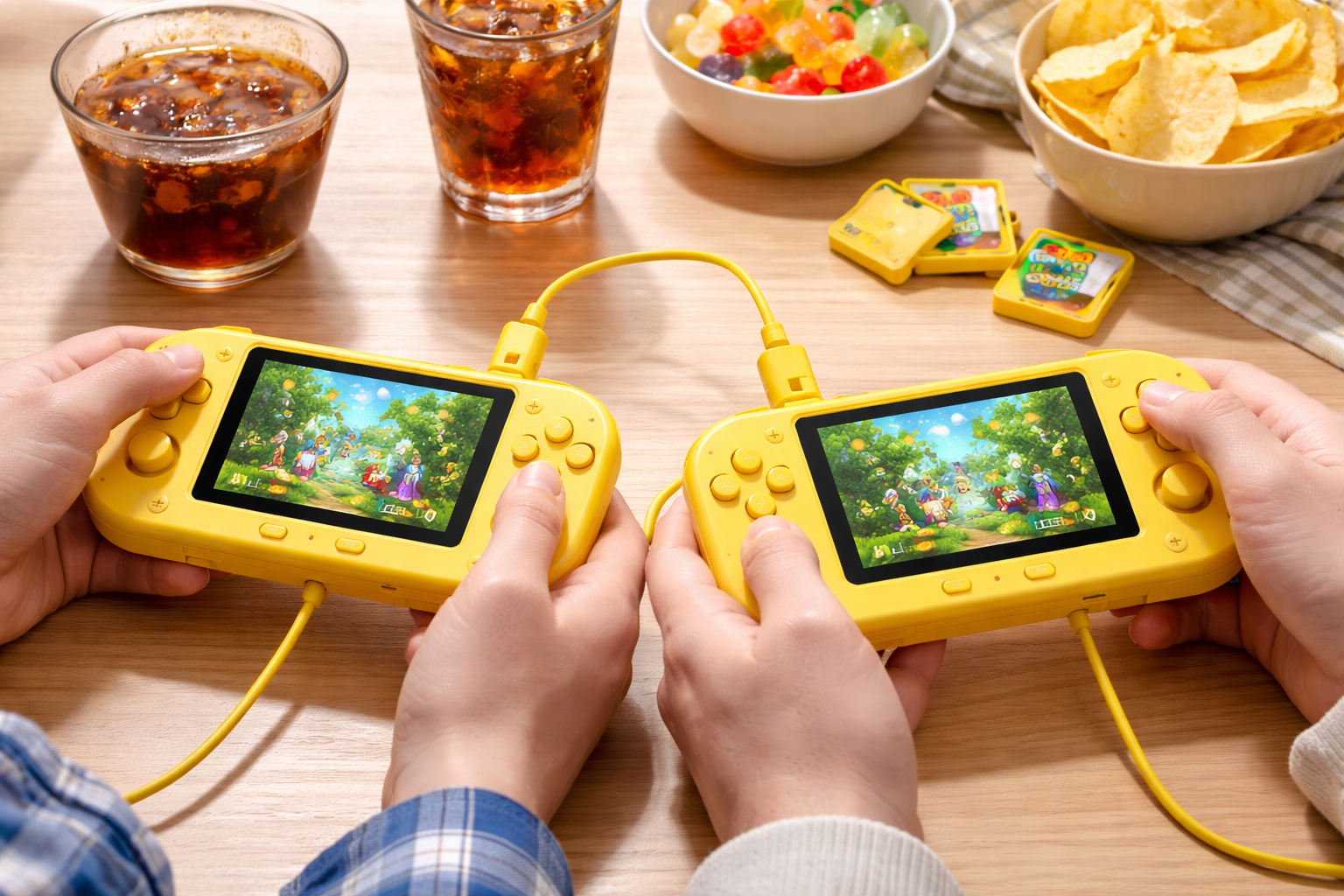
In an age dominated by wireless connections, cloud servers, and anonymous matchmaking, this bright yellow handheld console dares to do something radical: it requires a cable. Yes, a physical, unmistakably visible cable that connects two devices—and two players—together.
“How to Team Up: Cooperative Play With Friends (Yes, Real Ones)” isn’t just a feature description. It’s a philosophy. Instead of inviting players into distant digital lobbies, the console asks them to sit next to each other, share snacks, argue over strategy, and occasionally bump elbows in the heat of battle.
Why a Cable Makes All the Difference
The wired connection is more than a technical choice; it is a design statement. By physically linking two consoles, the system eliminates latency concerns while symbolically reinforcing cooperation. You cannot team up unless you are close enough to plug in.
This proximity changes gameplay dynamics. Players read each other’s facial expressions, react to laughter or frustration in real time, and coordinate tactics through natural conversation instead of voice chat. The result is a more immediate and emotionally engaging experience.
Built for Shared Moments
The cooperative mode was designed from the ground up to reward communication. Certain in-game puzzles require synchronized button presses, while boss encounters demand complementary abilities activated within seconds of each other. Success depends less on individual skill and more on teamwork.
Interestingly, playtesting revealed that even competitive personalities began to collaborate more effectively when seated side by side. The shared physical space encouraged spontaneous strategy discussions and quick problem-solving that would be harder to replicate online.
The Return of Tangible Gaming
Cartridges, cables, and compact screens may seem nostalgic, but they serve a practical purpose. By simplifying connectivity and removing complex network setup, the console makes multiplayer immediate and intuitive. Plug in, power on, and play—no passwords, no waiting rooms.
This tactile approach extends to the hardware itself. The comfortable grip and balanced weight make long cooperative sessions easy, while the durable casing ensures that excitement—sometimes expressed through enthusiastic gestures—does not interrupt the fun.
More Than Multiplayer
Ultimately, cooperative play with this console is about presence. It is about sharing a table, passing snacks, celebrating victories together, and laughing at unexpected in-game chaos. The wired connection becomes a visible reminder that gaming can still be a shared physical experience.
In a world where “online friends” often outnumber the people sitting beside us, this device invites players to reconnect—literally. Sometimes, the strongest signal isn’t wireless. It’s the one running directly between two consoles and the friends holding them.